Case study · Wonderwordle
A daily Oasis song-guessing game
A side project that started as a scrappy single-file prototype and became a daily game people actually play.
01
The problem
I had an idea about an Oasis game and wanted to see how far I could take it.
Context
Wonderwordle started as an idea over breakfast one morning: what if there was a Wordle for Oasis songs?
I vibe coded a quick version in Claude to see if it worked. It did, and I loved it. It was only a single HTML file, but it was already fun to play, so I decided to turn it into a proper online game. Then it took off.
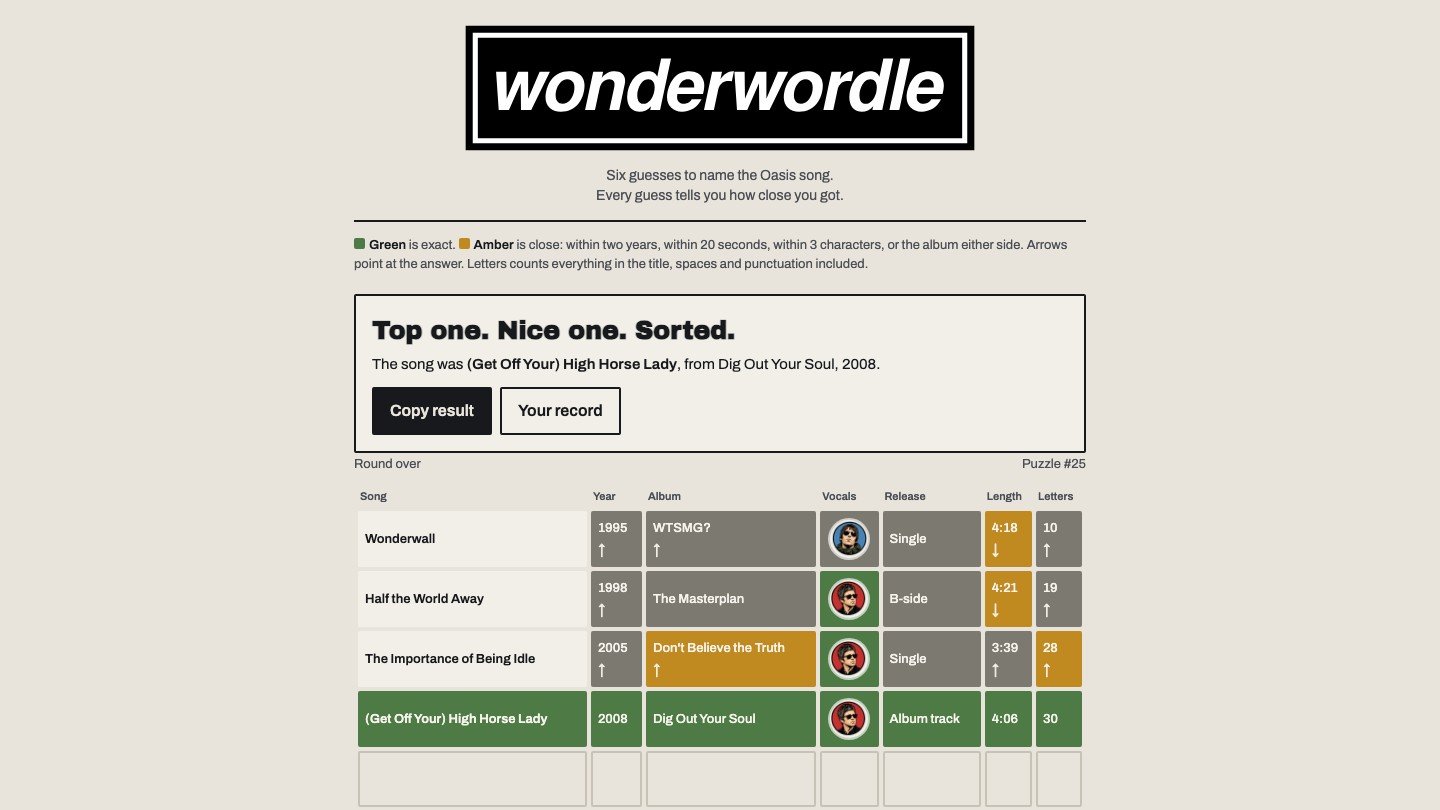
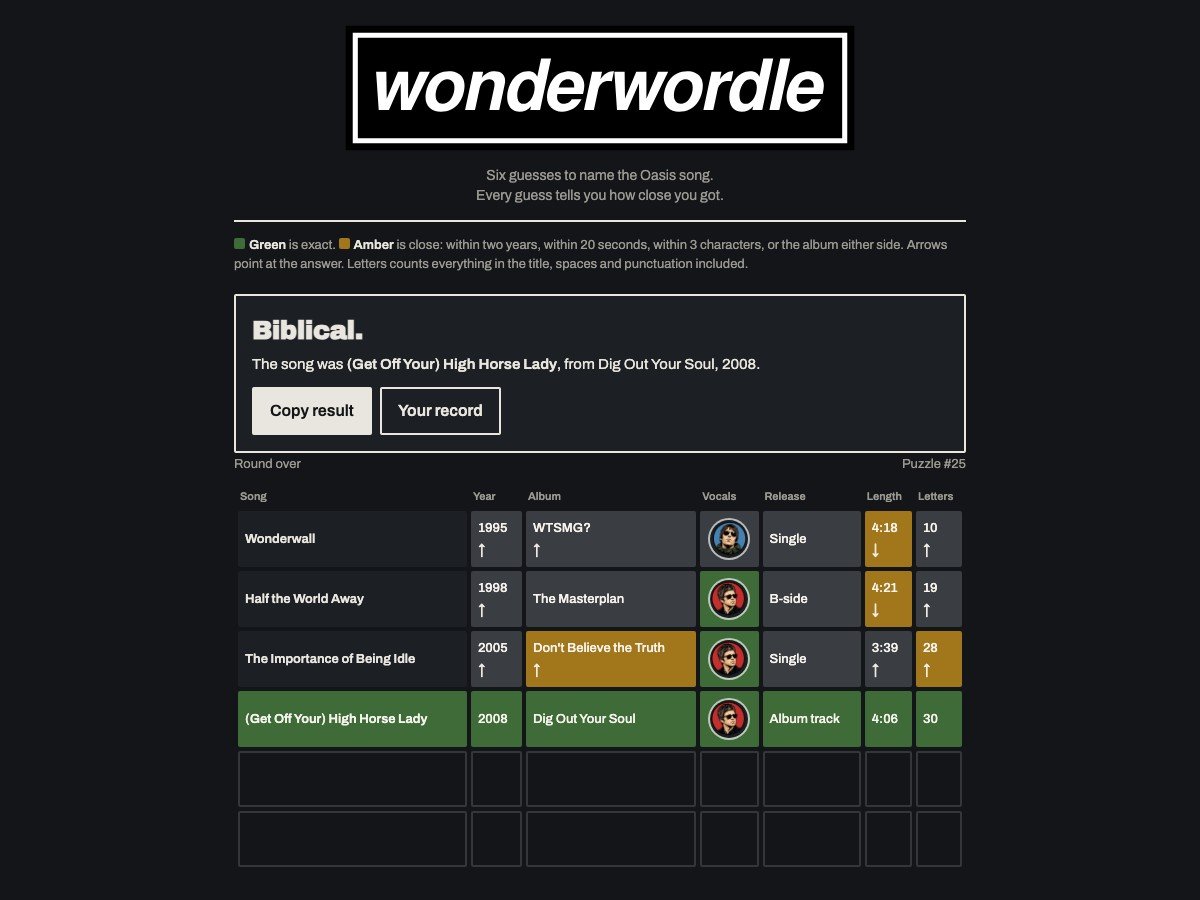
The game is simple. Every day there’s a hidden Oasis song, and you get six guesses to find it. Each guess tells you how close you are on six things: the year, the album, who sings it, whether it was a single, album track or B-side, how long it is, and how many letters are in the title. Green means you’ve got it, amber means you’re close, and arrows point you in the right direction.
The challenge
Going from a fun prototype to a game other people could play meant thinking about it as a product, not a toy.
It had to feel fair: one puzzle a day, the same for everyone, with no way round it by refreshing the page. It had to be easy to pick up on a phone, without needing much explaining. And it had to run itself, with clues people could trust, so players didn’t end up frustrated and I wasn’t fixing things by hand every day.
02
The solution
I rebuilt it properly, checked every song, and kept tweaking it once people started playing.
My role
It’s my project, so everything from the idea and the design to the song data and the launch was down to me.
Once the prototype proved the idea, I took it into Claude Code to rebuild it properly. I wrote the brief, made the product and design calls, and tested every change before it went live.
My approach
Roughly how it came together.
Vibe code
Built a quick version in Claude to see if the idea worked.
Rebuild properly
Rebuilt it in Claude Code as a fast site that runs itself.
Check the data
Checked every song so the clues are right and fair.
Launch
Put it live, then kept improving it from player feedback.
Starting again, properly
I rebuilt it in Claude Code as a fast, simple site that works well on a phone.
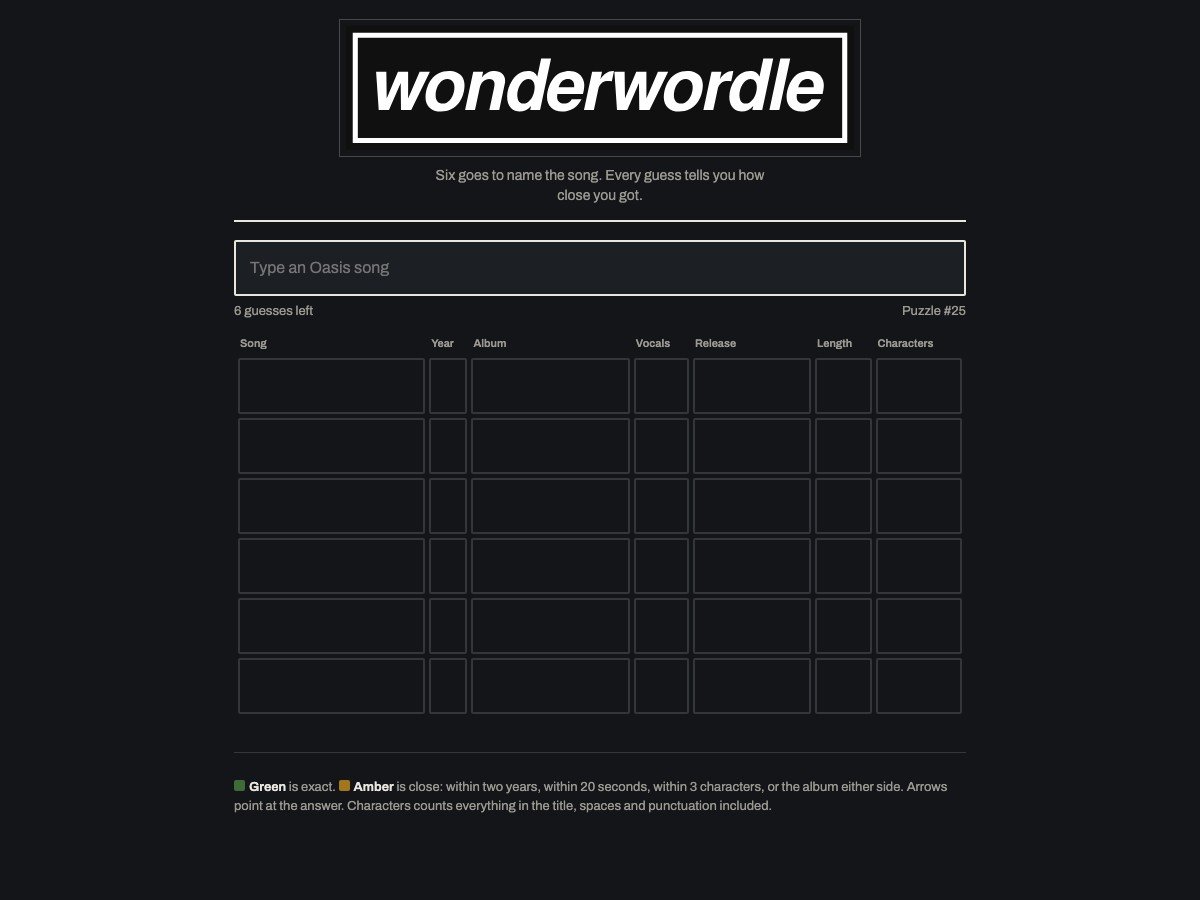
I kept the design direction from the prototype: a logo in the style of an Oasis sleeve, off-white paper, near-black type, muted green and amber, a heavy display font and flat borders. The full empty board shows as soon as the page loads, so you can see the shape of the game before you make your first guess.
One fair puzzle a day
Everyone gets the same song on the same day, and there’s nothing to sign up for.
Your progress saves in your browser, so a refresh doesn’t give you a second go, and coming back after you’ve finished shows your result. Once a puzzle has been played, its answer never changes, even when I update the song list.
Getting the data right
The clues are only useful if they’re right, and one wrong clue makes people doubt the rest.
I checked every song against proper sources before launch, and checked again whenever something looked off. That’s what makes the game feel fair rather than frustrating.
Finding the right song
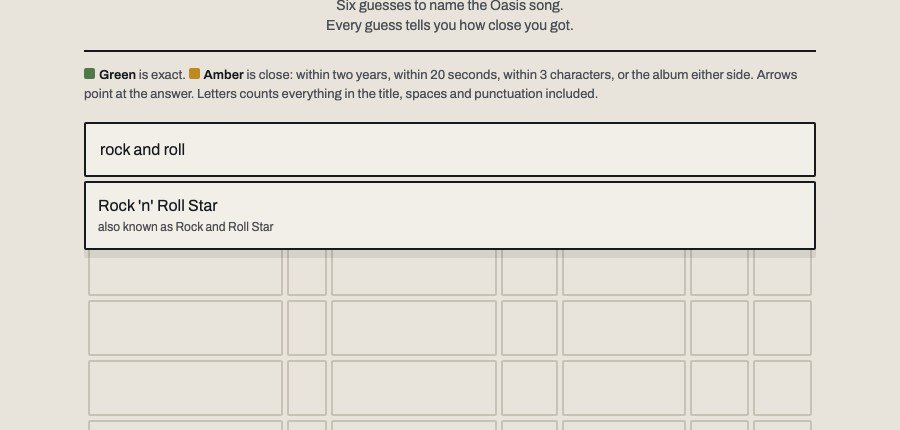
Nobody types song titles the same way, so the search had to be forgiving. It suggests songs as you type, understands common alternative spellings, and shows you which title it matched.
Listening to players
Once people started playing, I got feedback, and most of it was about small things that tripped them up.
The colour key used to sit below the board, so people didn’t see it until after they’d guessed. It’s now right under the instructions. When you finish a puzzle, the guess box disappears and your result shows up in its place, with buttons to copy your score or jump to your record.
The search box now says “Enter any Oasis album track”, and there’s a survey link at the bottom for anyone who wants to tell me more.
Launch assets
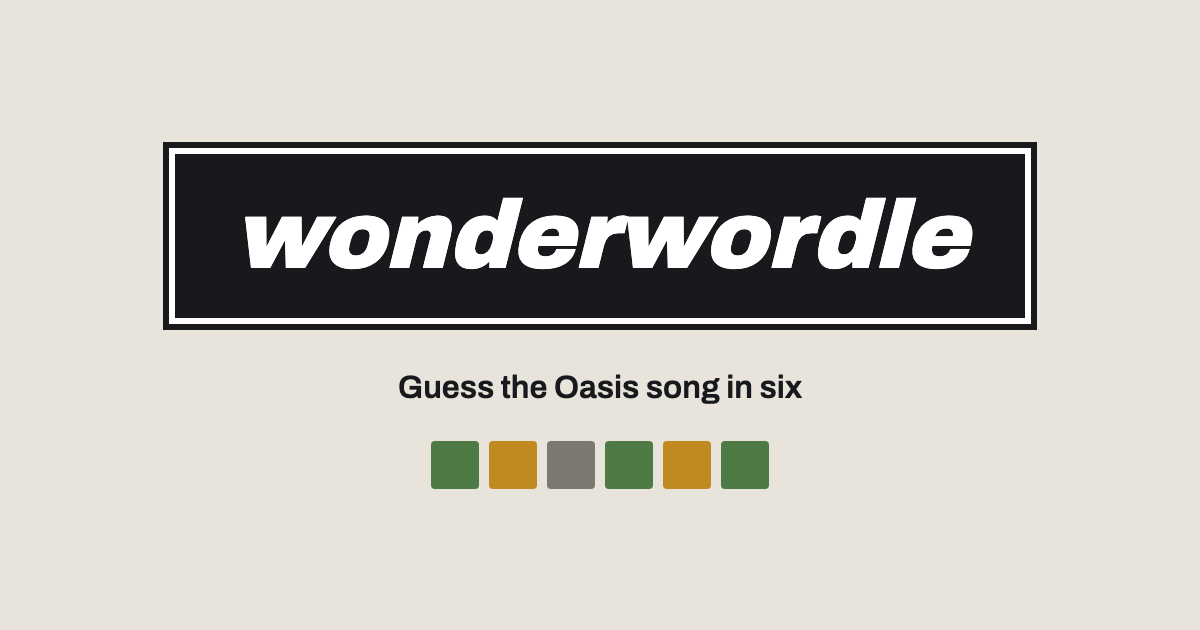
A share card and some social graphics, so the game looks right wherever it gets shared.
03
The result
923 people played on launch day, and it’s had steady daily traffic ever since.
Impact
The game’s live at wonderwordle.com with 91 songs in the pool. Everyone gets the same puzzle each day, refreshing won’t get you extra guesses, and the data behind every clue has been checked.
Launch weekend
Wonderwordle went live on Saturday 19 September 2026. 923 people played that first day, then 554 on the Sunday and 543 on the Monday. Since then the daily numbers have stayed pretty consistent.
I wanted to know more than how many people turned up, so I set up an event in Google Analytics that fires whenever someone wins. It records the puzzle number and how many guesses it took.
Put that next to the visit numbers and I can see how many people finish each day’s puzzle, and which songs gave people the most trouble. Losses aren’t tracked, so a visit without a win means someone either lost or wandered off.
What I learned
Getting the details right matters as much as the design. If one clue is wrong, people start doubting all the others.
A daily game also has to feel the same for everyone, every day, so some decisions need to be right from the start.
And putting it out early was the right call. Most of the improvements came from people telling me what confused them, not from me guessing.
Play today’s puzzle: wonderwordle.com